





For anyone dealing with agricultural land in Maharashtra, one of the most important land records to know about is the 8A extract. This helps in all aspects of property transaction- buying, selling and inheritance etc. In this guide, know the importance of 8A extract, how to read it and how to download it online.
What is the 8A extract in Maharashtra land records?
Maintained by Maharashtra’s revenue department, the 8A extract provides details of the revenue generated by the agricultural land in Maharashtra. This land record includes the tax levied on the land, the payments done, outstanding dues etc. thereby ensuring that all transactions with respect to that piece of agricultural land are transparent. This also has mutation entries-records of changes in ownership of the agricultural land. This complements satbara (7/12) that includes details such as land survey number, the area, ownership details, cultivation data etc.
See also: Mahabhulekh 2025: All about 7/12 land records in Maharashtra
What is 8A Khata Number?
The 8A Khata number is a unique identification number (UIN) that is allotted to a land owner and ensures that the owner listed in the 8A is linked with a dedicated land survey number.
With the help of 8A Khata number, one can verify the legality of the land, conduct mutation, proceed with land transactions like buying, selling etc. and fill property related applications with the revenue department.
See also: How to buy agricultural land in Maharashtra?
What is Gaav Namuna 8A Utara? How to read 8A extract in Maharashtra Land Record?
Gaav Namuna 8A Utara is the format that is used by the Maharashtra revenue department to generate the 8A extract. Known as the holding sheet of Khatedar, the form 8A covers details such as
-
- Survey number that identifies and marks the land parcel
- Sub-division of the survey number
- Village name, Taluka name, District name
- Owner name and addresses
- Khata number
- Area of land owned in hectare or acre
- Account number of land holder
- Amount of assessment tax payable by the land holder
- Mutation entry numbers
- Notes on legal disputes
Importance of 7/12 and 8A in Maharashtra Land Record
7/12 and 8A are two important parts of the Maharashtra Land Record and these complement each other. These two extracts together give details of the entire land in Maharashtra. While Maharashtra 7/12 gives details about agriculture such as primary ownership, tenancy, crops sown etc., the 8A extract gives details of the owner, the mutation entries, tax levied and paid and income generated etc.
How to check Maharashtra 8A Utara online?
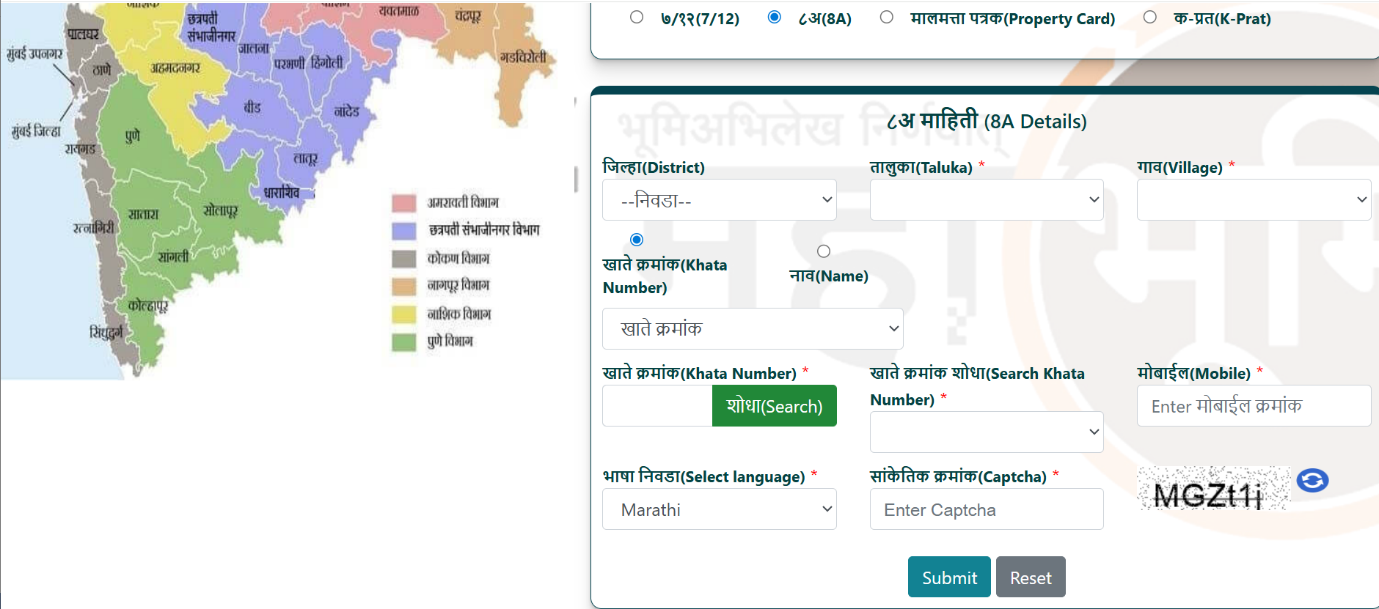
To check the Maharashtra 8A Utara online, log on to Mahabhulekh v2.0.
- On the page, select 8A as record of right.
- Select from drop down box details such as district, taluka, village, khata number/ name, language, enter mobile number and captcha and click on submit.

How to check Maharashtra 8A Utara offline?
To check the Maharashtra 8A Utara offline
- Visit the talathi office in the village
- Give a written application for access to 8A Utara. Include survey number and ID proof and give supporting documents.
- Once retrieved, collect the 8A Utara extract.
Tips to remember when accessing 8A Utara extract online
- Check whether all data entered is right so that the extract is right and accurate. Ensure that the extract that you receive has the right property information.
- Do not download the 8A extract from unauthorised unofficial websites as these may not match with your land details and you may enter into a fraudulent transaction. Also, if you are a buyer and checking owner’s 8A extract, ensure that the document produced is from Mahabhulekh v2.0.
- The 8A document gets updated and in case of an ownership transfer of tax levied/paid, the document sees an update. It is recommended to always download latest copy.
See also: Land purchase due diligence checklist 2025: Points to follow
Difference between 7/12 Utara, 8A Utara and Property Card
| 7/12 Utara | 8A Utara | Property Card |
| This is a combination of information of Form VII (owners) and Form XII (crops). | This includes details of current owners, revenue generated and tax levied, paid. | Mentions details of property owners, tenure and property related disputes if any. |
| This is used in rural areas for agricultural land. | This is used in rural areas for agricultural land. | This is used mostly in urban areas. |
| This includes land usage, details of cultivator, tenancy and ownership. | This is an important legal document that shows details related to mutation. | This is an important legal document that has updated ownership and valuation details. |
Housing.com POV
When dealing with agricultural land in Maharashtra, one cannot overlook the importance of the 8A Utara. With this document, one can ensure the owner name, mutations undergone within the property and any default in payment. These three points are extremely important when dealing with land buying/ selling. Also, note that in addition to checking the 8A extract, a buyer should checks all other relevant documents and if the agricultural land has been sold in line with state regulations. In case of any irregularity identified in sale/purchase of an agricultural land in Maharashtra, strict action may be taken depending on the case including sometimes the deal getting declared null and void and both parties penalised.
| Got any questions or point of view on our article? We would love to hear from you. Write to our Editor-in-Chief Jhumur Ghosh at jhumur.ghosh1@housing.com |