


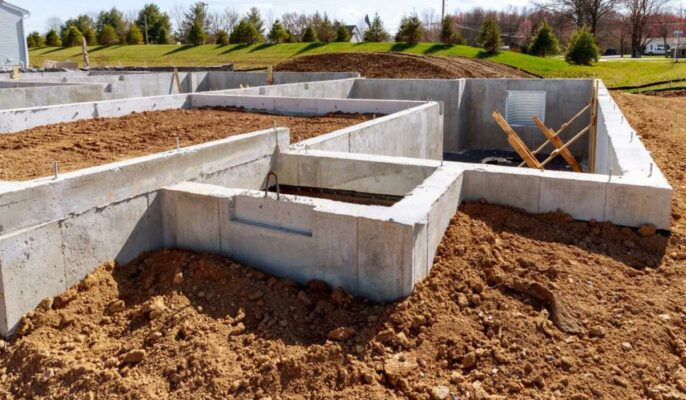


Constructing a sturdy foundation is a critical step in ensuring the durability and longevity of a home. This article provides a detailed overview of the process, outlining key steps and considerations.
Types of foundations for houses
Shallow foundations


Source: Pinterest (WordPress.com)
- Shallow foundations are ideal for level ground and hard surfaces, making them suitable for smaller projects like patio furniture or air conditioning units.
- They extend no more than 3 ft (91.44 cm) into the ground, providing ample support for lighter structures.
Deep foundations

Source: Pinterest (Anand Paul)
- Deep foundations are employed for more complex projects and on challenging terrains. They are crucial when soil conditions are poor or when building on an inclination.
- Deep foundations exceed 3 ft (91.44 cm) and can vary in depth throughout. This type is well-suited for structures like sheds or detached garages.
Foundation home layout and preparation
Site selection
Plot consideration
Finalise the plot area based on location, ground condition, and intended use.
Soil investigation
Thoroughly investigate soil conditions to identify any special treatment requirements.
Excavation work
Survey and mark
Conduct a precise survey of the land and mark out the layout plan in accordance with approved drawings.
Ensure precision
Ensure that the excavation work is carried out with precision, adhering to the specified dimensions and levels.
Anti-termite treatment
- Critical protection: Treat the soil up to plinth level with appropriate chemicals to safeguard your foundation home against termite damage.
- Professional expertise: This specialised treatment should be executed by a reputable agency with expertise in termite control.
Compaction and formwork
Compact the soil
- Establish a firm base
Apply brick flat soling followed by a layer of lean concrete to provide a solid and level base for the foundation home.
- Ensure stability
Proper compaction ensures that the foundation has a secure footing, preventing settling or shifting over time.
Wooden formwork


Source: Pinterest (pearsonpilings.com)
- Create a framework
Construct rigid forms according to the dimensions of the footing. It is crucial that these forms are strong and securely in place.
- Seal gaps
Properly seal any gaps in the formwork to prevent concrete from seeping out during pouring.
Reinforcement and pouring of concrete
Reinforcement steel (Rebar)
- Choose the right material
Use 500D TMT Rebar, particularly in regions prone to seismic activity, to reinforce the foundation.
- Precise placement
Ensure that the rebar is placed and fixed correctly, with adequate concrete cover blocks to prevent displacement during pouring.
Pour concrete


Source: Pinterest (Family Handyman)
- Mix and pour
Prepare the concrete mixture and pour it into the formwork. Use a trowel to level and compact the concrete to achieve a smooth finish.
- Ensure structural integrity
Proper pouring and compaction are essential to prevent voids or weak spots in the foundation.
Cure and finalise the foundation
Cure the foundation
- Commence timely curing
Begin curing the concrete the day after pouring, repeating the process two to three times daily.
- Ensure strength
Adequate curing allows the concrete to develop its full strength, enhancing the overall durability of the foundation.
Final checks and removal of forms
- Allow sufficient drying time
Leave the forms in place for at least 24 hours to ensure the concrete thoroughly dries.
- Prevent cracking
Keep the concrete moist if the weather is hot to prevent cracks from forming. Water it at least twice daily or more frequently in high temperatures.
Build a foundation for a garage
Layout and getting permits
- Define the area
Lay out the foundation area and mark the perimeter, ensuring no underground utilities are present.
- Obtain necessary permits
Prioritise obtaining any required permits before starting the project.
Excavation and footings
- Dig
Excavate the dirt for the footings and slab according to plans, adhering to building and safety codes.
- Formwork and rebar
Build forms for the footings and slab and install rebar for reinforcement.
Concrete work for garage foundation


Source: Pinterest (Sheds Unlimited)
- Pour concrete footings
Once the footings are prepared, pour concrete to create a solid base for the garage foundation.
- Slab construction
Depending on the design, construct the garage foundation with courses of cinder blocks or by casting a concrete wall using wooden forms.
Key considerations for the construction of home foundation
Local regulations and codes
- Adhere to standards
Ensure compliance with local building codes, considering factors such as frost lines, water tables, and soil stability.
Choose the right materials
- Quality cement for longevity
Choose high-quality concrete and reinforcement materials to guarantee the foundation’s longevity and strength.
Professional guidance
- Consult experts
Seek advice from structural engineers or consultants, especially in regions with unique soil conditions or geological challenges.
FAQs
How do I start a foundation construction?
To begin foundation construction, start by obtaining necessary permits, conducting a site survey and marking out the layout according to approved plans.
Can I lay a foundation myself?
Yes, you can lay a foundation yourself with proper planning, knowledge and adherence to local building codes and safety measures.
Which foundation is the strongest?
Reinforced concrete foundations are generally considered the strongest due to their durability and load-bearing capacity.
How deep should a foundation be?
The depth of a foundation depends on factors like soil conditions and building type, but it typically ranges from 3 to 4 feet for shallow foundations and deeper for more complex structures or poor soil conditions.
What is the size of a footing?
The size of a footing typically ranges from 60 cm to 120 cm in width and 25 cm to 30 cm in thickness.
How do you calculate footing size?
To calculate footing size, consider factors like soil type, load-bearing capacity, and the structure's weight, then consult a structural engineer for precise dimensions.
How thick is a foundation?
A foundation is typically 30.48 cm thick but may vary based on factors like load and soil conditions.
What is the foundation structure of a house?
The foundation structure of a house is the load-bearing component that supports the entire building, transferring its weight to the ground.
What are the four types of foundations?
The four types of foundation are shallow, deep, slab-on-grade and pier foundation, each suited for specific soil conditions and structural requirements.
Which foundation is best for construction?
The best foundation for construction depends on factors like soil type, local climate, and the structure's design, with options including slab-on-grade for simplicity, or deeper foundations for more complex projects or challenging soil conditions.
| Got any questions or point of view on our article? We would love to hear from you. Write to our Editor-in-Chief Jhumur Ghosh at jhumur.ghosh1@housing.com |