


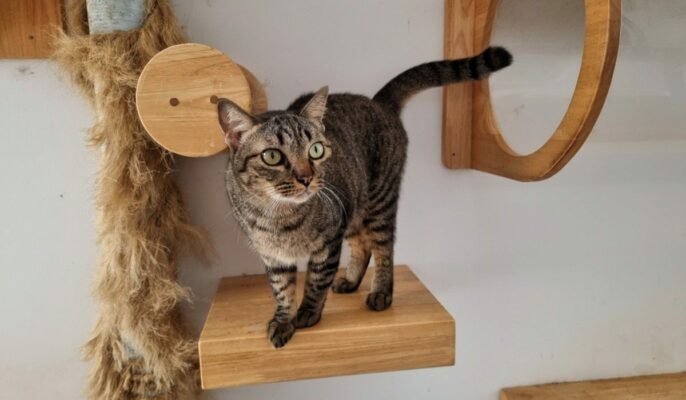


Creating a DIY cat tree can be an enjoyable and straightforward project. Once you grasp the fundamentals of building a cat tree, you can get creative by incorporating artificial tree limbs, additional tiers, or covering supports with rope and carpet to craft a cat scratching post. Begin with the essentials, and feel free to explore your own design ideas, whether it’s crafting a cat condo, a cardboard cat house, or even purchasing pre-made scratch posts and cat trees to cater to your pet’s preferences.
See also: How to build a dog house?
Steps to make a DIY cat tree


Source: Mau (Pinterest)
Creating a basic DIY cat tree is an easy and budget-friendly project. Here are the steps to guide you in making your own:
- Plan and design: Begin by selecting the location where your DIY cat tree will be placed. This will determine the size you need. Look for cat tree plans and explore various cat furniture designs to gather inspiration and ideas.
- Gather materials: For the vertical posts or supports, you can use dimensional lumber, sturdy cardboard tubes or PVC pipes. Plywood panels work well for the platforms. Use a handheld circular saw or a table saw to cut the plywood and a hand saw for lumber. Sand the edges to smooth them out. Cardboard can be used for creating cat houses and cubbies.
- Build a stable base: Ensure your cat tree has a sturdy and non-tipping base. Cut two plywood sheets to the size you desire and glue these sheets together to craft a heavier base. A 24-inch square base is a good starting point, but you can go large if needed.
- Wrap in carpet: Cut a piece of carpet a few inches bigger than the base. Wrap it over the edges and use a staple gun to secure it in place. If necessary, notch the carpet’s corners to ensure it folds neatly.
- Cover vertical supports: Wrap the vertical supports with pieces of carpet before attaching them to the base. Use wood glue, nails, or screws to secure them, ensuring there are no exposed screws, staples or sharp items that could harm your cat.
- Attach horizontal platforms: Secure the horizontal platforms using glue or wood screws. After attaching them, use a piece of carpet to cover the platforms, hiding the screws. Staple the carpet pieces underneath the platforms to keep it in place.
- Final touches: Make any necessary adjustments to ensure your DIY cat tree is strong and stable. Double-check all connections and coverings to ensure they are secure and safe for your cat.
How to make a DIY cat tree with branches?


Source: Bored Panda (Pinterest)
Creating a DIY cat tree with artificial tree branches can be a delightful project for your pet. Here’s a guide on how to do it:
- Start with a cat tree base: You can either begin with a ready-made cat tree or create your own using the instructions mentioned above. Ensure the base is stable and sturdy to prevent tipping when your cat climbs it.
- Prepare a wooden box: Construct a simple wooden box around the artificial tree trunk’s base. The box should encase the base securely and add weight to prevent tipping. Make sure it’s well-anchored to the base.
- Choose artificial tree branches: Select artificial tree branches or limbs that will serve as perches for your cat. You can attach these branches to the wooden box or other support. Make sure they are securely fastened to withstand your cat’s weight and movements.
- Add platforms: Incorporate one or more platforms between the artificial branches. These platforms can provide resting spots for your cat. Ensure they are securely attached and can bear the weight of your cat.
- Safety and stability: Double-check the stability of the entire cat tree structure. Ensure that all attachments are secure and that there are no sharp edges or exposed fasteners that could harm your cat.
How to build a cat tree tower?


Source: PureWow (Pinterest)
Creating a cat tree tower by expanding on your basic cat tree design can be a rewarding project. Here’s how to do it:
- Expand with additional platforms: Begin with the cat tree structure by following the previous steps. To convert it into a cat tree tower, you’ll need to add more platforms. These additional levels will allow your cat to climb higher.
- Stagger the platforms: Position the new platforms at different heights and angles, so that your cat can easily jump between them.
- Incorporate cosy spaces: Consider adding cubes, or cubbies to some of the tower’s platforms to provide your cat with snug spaces to nap. To do this, either use a durable box or glue study pieces of cardboard together to create a cube. Ensure the cube is spacious enough for your cat to comfortably enter and exit. Cut a square or round opening in one end of the cube, allowing your pet to move in and out freely. Place soft padding at the bottom of the cube and cover it with a cosy blanket to create a snug bed. For the exterior of the cube, glue fabric, apply non-toxic paint or attach carpet using staples or glue. Allow adequate time for any glue or paint used on the cube to dry completely before allowing your cat to use the tree tower.
How to make a wall-mounted cat tree?


Source: Amazon.com (Pinterest)
To create a wall-mounted cat tree, you’ll need wooden shelves or platforms, screws, wall brackets with appropriate weight-bearing capacity, wall anchors, screwdriver or drill, carpenter’s level and a soft carpet or other non-slip material. Here’s how to build a wall-mounted cat tree.
- Plan the layout: Determine the layout of your wall-mounted cat tree or shelves. Consider the available wall space and height you want to reach. Ensure that the chosen location allows your cat to easily access and use the tree or shelves.
- Locate wall studs: Use a stud finder to locate the wall studs in the chosen area. Wall studs provide the necessary support for your cat tree or shelves. It’s crucial to anchor your installation to studs for stability.
- Install wall brackets: Attach the wall brackets to the wall at the desired heights. Make sure the brackets are securely fastened to the wall studs using screws. Use a carpenter’s level to ensure that the brackets are level.
- Attach shelves: Place the wooden shelves or platforms onto the brackets. Ensure they fit securely and are level. Screw the shelves into the brackets to secure them in place. If your shelves don’t come with brackets, you may need to purchase compatible brackets separately.
- Add non-slip material: For added comfort and stability, you can cover the shelves with soft carpet or another non-slip material. This provides your cat with better footing and makes the shelves more inviting.
- Stagger shelves: If you’re installing multiple shelves, stagger them to the left and right as they ascend towards the ceiling. This provides your cat with a climbing experience like a tree.
What other structures can you build for your cat?
In addition to cat trees, there are plenty of other fun projects you can take up for your cat.
How to make a cat hammock


Source: Martha Stewart (Pinterest)
To create a cat hammock, you’ll need a large square piece of soft, sturdy fabric, a string or cord, utility knife, chair or other sturdy support, cardboard box, paint and brush and an old blanket. Here’s how to make a cat hammock.
Fabric hammock
Take a large square piece of soft and durable fabric. The size depends on your preference, but it should be large enough for your cat to comfortably lounge in. In each corner of the fabric, cut small slits or holes. These will be used to attach the hammock to a support. Determine where you want to hang the hammock. You can hang it beneath a sturdy chair or from the ceiling using string, or cord. Ensure that the chosen location is secure and safe for your cat. Then, hang the hammock.
- If hanging from a chair, thread a piece of string or cord through the holes in the fabric corners. Securely tie one end of the string to each chair leg or to the underside of the chair. Adjust the height of the hammock to your cat’s preference, make sure it is safe above the floor.
- If hanging from the ceiling, attach a hook or anchor to the ceiling in your chosen location. Thread the string or cord through the holes in the fabric corners. Tie one end of the string to the hook or anchor on the ceiling. Adjust the height to your cat’s liking.
Cardboard box cat hammock
- Take a large, sturdy cardboard box and seal it securely on the top and bottom.
- Use a utility knife to carefully cut a large window on each side of the box to create ventilation and visibility.
- If you’d like to add a decorative touch, paint the outside of the cardboard box in your preferred colours.
- Allow it to dry completely.
- Place the box on top of an old blanket or soft fabric.
- Trace around the bottom of the box, adding about four inches to each side.
- Cut along the traced lines to create a fabric piece that matches the bottom of the box.
- Make three-inch slits in each corner of the fabric.
- Cut corresponding slits in each corner of the cardboard box, several inches above the bottom.
- Pull one corner of the fabric through each slit in the box.
- Tie the fabric securely to the box, ensuring the hammock has room to hang.
How to build a cat condo?
Creating a cat condo from a DIY cat tree involves adding extra plywood platforms to accommodate multiple cats. To craft a basic cat condo with a built-in scratching post, wrap sisal rope around a vertical support from top to bottom and securely fasten it to wall studs. Alternatively, you can opt for another cat condo design using metal brackets to attach robust wicker baskets featuring plush padding vertically along a support. Arrange these baskets at various heights, staggering them from one side of the support to the other for a multi-level play and relaxation space.
How to make a cardboard cat house?


Source: Donna Marrin (Pinterest)
Creating a cardboard cat house is a straightforward DIY project. Begin by repurposing a robust cardboard or moving box. If necessary, reinforce any openings using clear packing tape or duct tape. Cut or leave an opening to provide your cat easy entry and exit. Next, paint the house in your preferred colours and allow it to dry thoroughly before introducing it to your cat. Furnish the interiors with a soft towel, blanket, or cushion to provide a cosy and inviting space.
How to build cat steps?
Creating cat steps is a practical project to enhance your pet’s mobility. To begin, measure the furniture piece your cat will access with these steps, determining their width and height accordingly. Keep the age and mobility of your cat in mind during this process. With the help of a circular saw, cut the sides of the steps, also known as stringers, from plywood panels. Attach a supportive frame to the stringer’s base and back for stability.
If desired, enclose the back of these steps with a piece of plywood. Secure the risers by applying glue on them and reinforcing them with large finishing nails once the glue has dried. You can opt to paint or stain these steps to your liking. Cover the treads with carpet or leave them bare according to your preferences. If woodworking isn’t your forte, you can consider purchasing a simple ramp and add carpeting both a scratching surface and improved traction.
How to make a cat scratching post?


Source: Etsy (Pinterest)
To begin, nail or staple carpet onto the vertical supports of your cat tree to craft an effective scratching post. Alternatively, wind rope tightly around the support, starting from the bottom and going up, ensuring the loops are close together. Staple the rope in place as you go along. You may need to use a hammer to secure the staples firmly through the rope and into the supports. Remember to replace the carpet or rope when it becomes significantly frayed.
FAQs
What material is used for cat scratching posts?
Cat scratching posts are commonly covered with sisal rope. However, sisal fabric is a superior choice. When a cat scratches sisal rope, its fibres can become dislodged and sharp, dissuading further use. In contrast, sisal fabric becomes softer as it's scratched, encouraging more use.
Are cat trees easy to make?
Crafting a DIY cat tree is an enjoyable task. Once you've mastered the art of building a cat tree, you can customise it by incorporating artificial tree branches, multiple levels or adding rope and carpet around supports to create your own cat scratching post.
What wood is the best for outdoor cat trees?
Cedar is an excellent choice for outdoor cat enclosures. It's an aromatic, versatile, durable, and sustainable wood option.
Can I use cotton rope for cat tree?
Yes, both cotton rope and twisted manila rope can be used for crafting a DIY cat scratching post.
Is it good to have a cat tree?
Yes, having a cat tree can be highly advantageous for cats. As cats have natural instincts to seek high vantage points for safety and monitoring their surroundings, a cat tree provides them with a secure escape from ground-level disturbances like dogs, toddlers, and household noises.
Is wooden cat tree better?
Indeed, natural wood or manufactured wood is a superior option for cat trees. Cats tend to treat wooden furniture with more respect compared to carpet or plush coverings. Wooden cat trees not only look more attractive but also offer greater durability over time.
Can you use jute on a cat tree?
Jute rope is an excellent choice due to its good tear and abrasion resistance, making it highly durable. It has an appealing appearance and soft texture, making it a great replacement for repairing old and worn-out ropes on cat trees or scratching posts.
| Got any questions or point of view on our article? We would love to hear from you. Write to our Editor-in-Chief Jhumur Ghosh at jhumur.ghosh1@housing.com |