


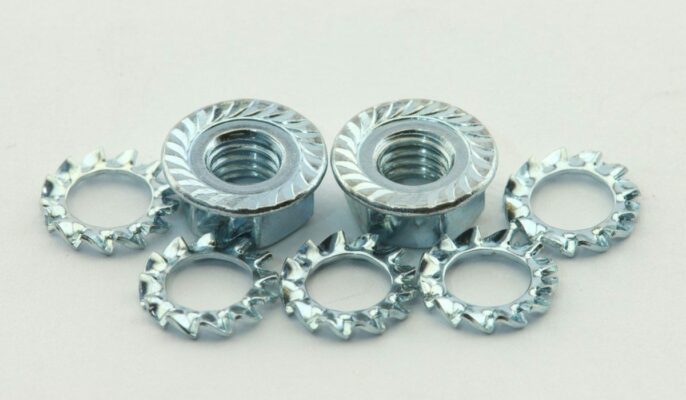


A locking washer is the latest update on the standard washer. These types of washers share additional pressure on the nut and bolt to keep them together. Typically, this happens by designing washers with pressures that avoid compression. They act as a spring pushing against the joint to keep the threads in contact during vibration and load changes. Locking washers also increase the friction between a nut or bolt’s head and its matching parts, making it more resistant to turning and loosening.
See also: Types of screw and their use
How locking washers work?
Connectors loosen due to two factors: decreasing and random self-loosening. Rotational loosening, also known as natural self-loosening, happens when a fastener is pressured by active use.
After the fastener has been tightened, the material below it settles, a process known as slackening. Some materials, particularly softer ones, are at risk of heavy settlement. The fastener’s stress is released by the settlement of these materials, causing it to loosen.
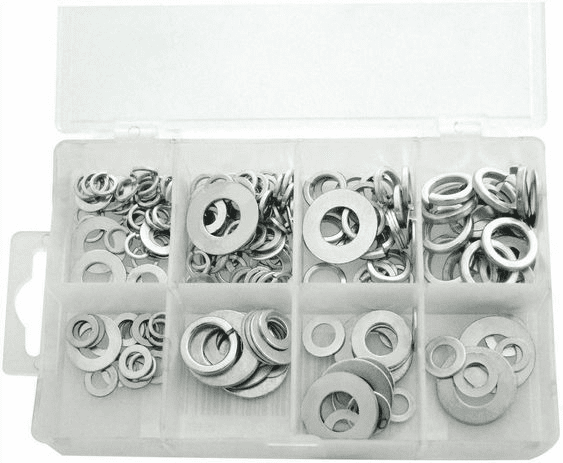

Source: Pinterest (eBay)
Types of locking washers
Split locking washer
Split locking washers have two opposite surfaces as a result of the breaking. The bolt is held in place by friction caused by the sharp edges and the material being bolted, which falls into each side of the joint gently.
This type of washer is most useful when a bolt must be pushed with light pressure into an extremely soft material, such as soft metal, wood, or plastic. If the bolt is tightly torqued, the split ring reduces and becomes damaged.
High collar locking washer
A high collar is strongly thicker and springier than a split washer. These washers can be used in similar ways, but they have a much higher pressure capacity.
Internal serrated washer
Internal serrated washers function similarly to external serrated washers, with the difference that the teeth are on the inside rather than the outside. As a result, they are suitable for smaller head bolts or situations where the teeth must be hidden.
External serrated washer
External serrated washers have teeth around the edge but otherwise look and feel like regular washers. To create contact, the serrated edge gets into the materials. They are frequently used by appliances, ventilation systems and various electrical connections.
Belleville washer
A Belleville washer, also known as a conical spring washer, is a conically shaped washer with no splits or serrations. When a load is applied to the washer, its conical shape allows it to become elastic, protecting the bolt’s pressure and avoiding bolt creep.
The lack of cracks or serration is beneficial when used in applications where the material’s surface may be affected. Conical washers can be placed to improve their spring action and carry greater weight.
How to use a locking washer?
Choose a locking washer
Choose the appropriate locking washer for the purpose and to determine the correct size, measure the bolt’s head. When choosing a washer, consider whether the application requires a bolt that must be securely torqued. If a serrated washer is used, ensure that its teeth rest against the bolt.
Choose a secondary washer
To efficiently spread the bolt’s stress on the material, a fender washer (a regular washer with a big outer diameter) may be required behind the locking washer on occasion. When doing this, always place the locking washer between the bolt and the ordinary washer.
Tighten the fastener
Use a screwdriver to tighten the fastener. If exact pressure is necessary, a torque wrench should be used.
Warning
Overtightening a locking washer has the same bad effect as under-tightening, which is clearly useless.
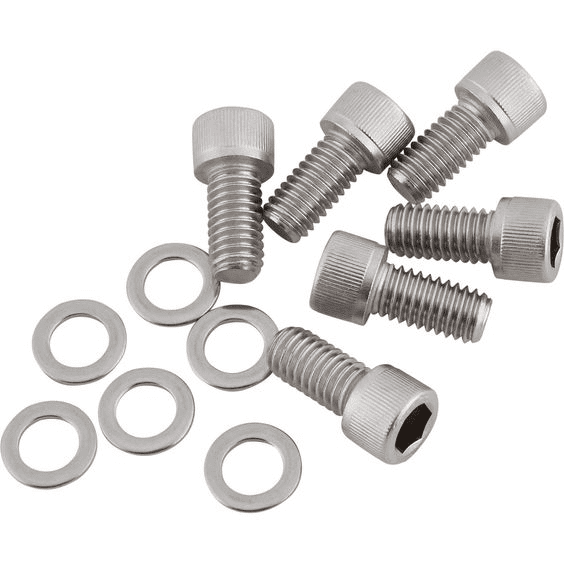

Source: Pinterest (Speedway Motors)
How to remove a locking washer?
Loosen fastener
Use a screwdriver to loosen and remove the fastener.
Tip: If you are having difficulties removing a bolt or nut, spray it with penetrating oil and let it rest. Before attempting to remove the bolt, slide a short piece of metal pipe over the end of the gear to enhance its strength.
Remove the locking washer
The locking washer frequently falls off with the fastener when it is removed. To remove stubborn locking washers, use a flat-head screwdriver. Simply push up the locking washer with the tip of the screwdriver. Using a screwdriver in the split washer may work nicely.
FAQs
Do locking washers work with all materials?
They work well with most materials but compatibility should be considered.
Are there alternatives to locking washers?
Thread-locking adhesives can serve a similar purpose.
Do locking washers require maintenance?
No. They do not need regular maintenance once installed.
Can the locking washer be reused?
It is better to use a new one to ensure proper function.
Which side of the locking washer faces the material?
The toothed or concave side of the locking washer faces the material.
| Got any questions or point of view on our article? We would love to hear from you. Write to our Editor-in-Chief Jhumur Ghosh at jhumur.ghosh1@housing.com |