
The Hyderabad Metro is a rapid transit system developed to provide connectivity to the city. It is the third longest operational metro network after the Delhi Metro and Bangalore Metro network. In 2017, a 30-km section connecting Miyapur and Nagole was inaugurated on November 28, 2017. Hyderabad Metro has three fully operational lines and one under-construction line. The project, managed by Hyderabad Metro Rail Limited (HMRL), is being developed in two phases at a cost of Rs 18,114 crore.
A joint venture is expected to be set up between the Centre and Telangana government with a 50:50 share for the development of Hyderabad Metro Phase 2 expansion. The Hyderabad Metro project was earlier implemented by the state government in partnership with Larsen and Toubro group. However, after the L&T’s exit from the project, the Hyderabad Metro transitioned to a fully government-run project.
Currently, the Hyderabad Metro has 69 km of operational section across three corridors. The Hyderabad Metro is currently witnessing expansion under Phase 2 and Phase 3. Once completed, the Hyderabad Metro will have a total length of about 115 km, providing connectivity to key areas, including the international airport, IT hubs, commercial areas and educational hubs in the city.
Hyderabad Metro: Quick facts
| Owner: | Hyderabad Metro Rail Limited (HMRL) |
| Estimated cost: | Rs 18,114 crore |
| Number of metro lines: | 3 fully operational and 1 under construction |
| Line number: |
|
| Total stations: | 59 |
| Fare: | Rs 10-60 |
| Timing: | 6 AM to 11 PM |
| Average speed: | 35 to 40 kmph |
This is the largest metro project developed on a public-private partnership.
Hyderabad Metro project status
The Hyderabad Metro is currently operational along three metro lines – the Red line from Miyapur to LB Nagar, the Green line from JBS Parade Ground to Falaknuma and the Blue line from Raidurg to Nagole.
The Hyderabad Metro expansion projects are in the planning stage. The Telangana government submitted the detailed project report (DPR) and the required documents for the Phase 2B proposal to the central government. The project aims to extend the existing metro network by 86.1 km at an estimated cost of Rs 19,579 crore.
Telangana Assembly clears resolution to take over Hyderabad Metro phase-I from L&T
March 31, 2026: The Telangana Legislative Assembly has approved a resolution endorsing the state government’s decision to take over phase I of the Hyderabad Metro Rail project from L&T. It has also urged the Union government to grant early approval for Phase II expansion. Chief Minister A Revanth Reddy said that Phase I currently covers 69 km and proposals for Phase 2A (76.4 km) and Phase 2B (86.1 km) have been submitted to the Union government.
Telangana government allocates Rs 1,100 crore for Hyderabad Metro Project in 2026-27
March 23, 2026: The state government has allocated Rs 1,100 crore for the Hyderabad Metro Project in 2026-27. Of the total budget allocated, Rs 600 crore has been earmarked for the Phase 2 metro, while Rs 500 crore will be extended as loans to HMRL for project implementation.
Old City metro expansion work begins
The Hyderabad metro extension project through the Old City corridor is picking up pace as the Hyderabad Airport Metro Limited (HAML) has confirmed that technical groundwork on the 7.5 km section between Mahatma Gandhi Bus Stand (Imlibun) and Chandrayangutta is progressing. According to HAML, the land acquisition and demolition of affected properties in the Old City Metro Corridor have reached a crucial stage, with the required Right of Way (RoW) being almost available now. Compensation to the tune of Rs 433 crore has been disbursed to property owners. Preparatory works for Metro pillars and station construction were in full swing, as per reports.
According to HMRL, officials have set out ground control points (GCPs) with Trimble DGPS in the old city stretch.
Hyderabad Metro route map
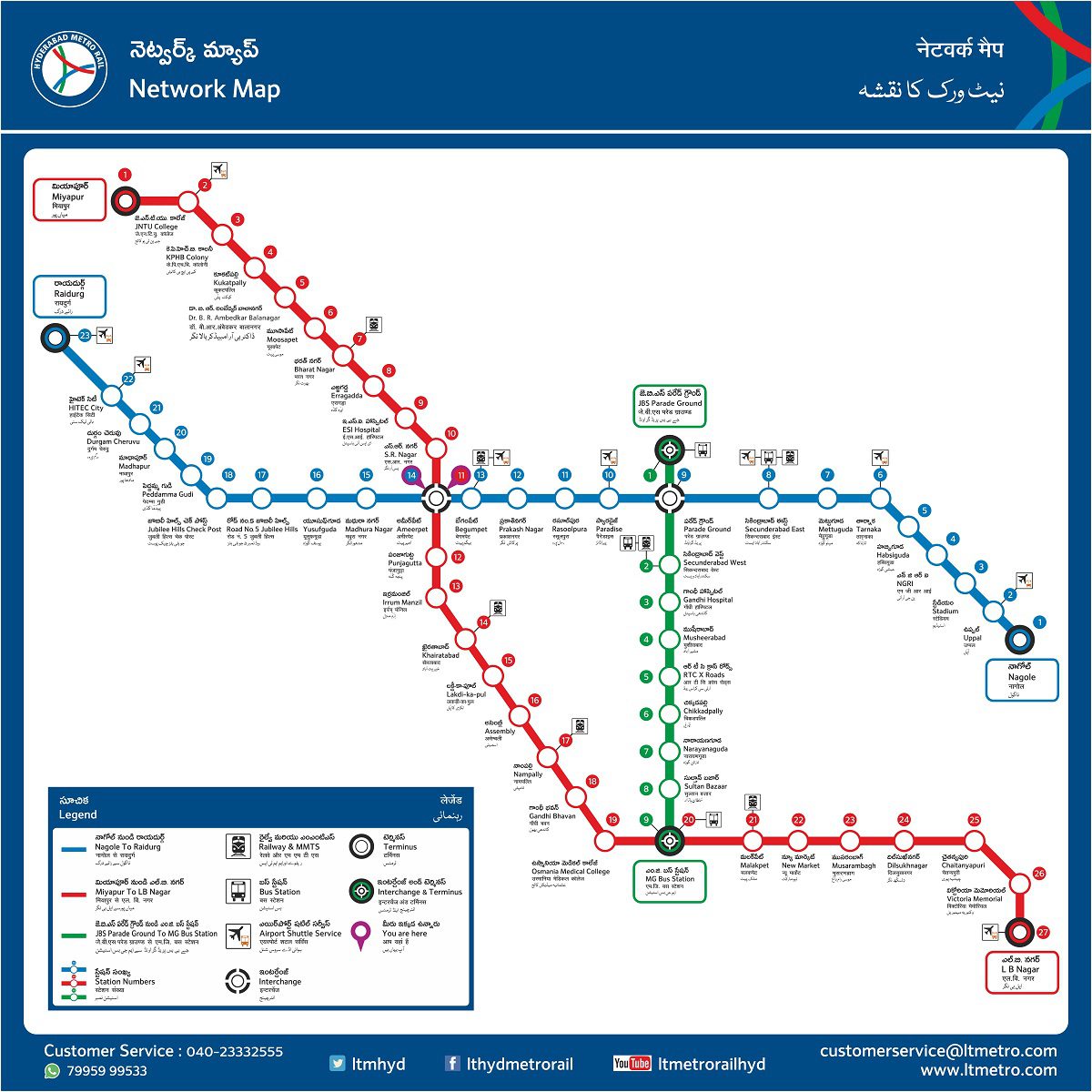
(Source: ltmetro)
Click here to view the Hyderabad metro map pdf
Hyderabad Metro operational corridors
With three operational corridors, i.e., Blue Line, Red Line and Green Line, the metro network covers the most crucial transport nodes in the city.
Click here to download PDF.
Hyderabad Airport Metro line to be extended up to Mindspace junction
The Hyderabad Airport Metro Limited will extend the current Blue Line from Nagole till Mindspace Junction. Mindspace Junction is a proposed multi-level station, about 800 metre from the Raidurg Terminal Station. “The new multi-level station, which will be named later, will have a common concourse with a non-ticketing and ticketing area, followed by the Airport Metro station and on the top most tier will be the extended Blue Line Raidurg terminal station,” Hyderabad Airport Metro Limited MD NVS Reddy. The proposed Airport corridor project of Hyderabad metro will be completed in 3 years. Meanwhile, work is underway to complete Phase-1 pending work. There are plans to expand metro rail services to the Ramoji Rao Film City and other areas of the city.
Hyderabad Metro Blue Line
Distance covered: 27 km
Stations: 23
Interchange stations: 2
- Ameerpet (Red Line)
- Parade Ground (Green Line)
Blue Line station list
- Nagole
- Uppal
- Stadium
- NGRI
- Habsiguda
- Tarnaka
- Mettuguda
- Secunderabad East
- JBS Parade Ground
- Paradise
- Rasoolpura
- Prakash Nagar
- Begumpet
- Ameerpet
- Madhura Nagar
- Yousufguda
- Jubilee Hills Road No 5
- Jubilee Hills Check Post
- Peddamma Temple
- Madhapur
- Durgam Cheruvu
- HITEC City
- Raidurg
Click here to see the Hyderabad Metro Blue Line route.
As per media reports, the Hyderabad Metropolitan Development Authority (HMDA) has planned an elevated corridor that will pass below the Begumpet Airport runway through a tunnel for around 600 meters. This will pose challenges to the Paradise-Bowenpally Metro corridor alignment. The government is exploring alternative routes, including the feasibility of initially combining the Paradise-Medchal and JBS-Shamirpet sections before splitting them later.
Hyderabad Metro Red Line
Distance covered: 29 km
Stations: 27
Red line station list
- Miyapur
- JNTU College
- KPHB Colony
- Kukatpally
- Balanagar
- Moosapet
- Bharatnagar
- Erragadda
- ESI Hospital
- SR Nagar
- Ameerpet
- Punjagutta
- Irrum Manzil
- Khairatabad
- Lakdi Ka Pul
- Assembly
- Nampally
- Gandhi Bhavan
- Osmania Medical College
- MG Bus Station
- Malakpet
- New Market
- Musarambagh
- Dilsukhnagar
- Chaitanyapuri
- Victoria Memorial
- LB Nagar
Click here to see the Hyderabad Metro Red Line route.
Know about: Hyderabad rental houses
Hyderabad Metro Green Line
Distance covered: 15 km
Stations: 9
Interchange stations: 2
- Parade Ground (Blue Line)
- MG Bus Station (Red Line)
Green line station list
- JBS Parade Ground
- Secunderabad West
- Gandhi Hospital
- Musheerabad
- RTC Cross Roads
- Chikkadpally
- Narayanguda
- Sultan Bazaar
- MG Bus Station
(Yet to be operational)
- Salarjung Museum
- Charminar
- Shalibanda
- Shamsher Gunj
- Jungametta
- Falaknuma
Click here to see the Hyderabad Metro Green Line route.
Hyderabad Metro Purple Line
Distance covered: 36.6 km
Stations: 24
Interchange stations: 3
Purple line station list
| Metro station | Layout | Interchange |
| Nagole | Elevated | Blue line |
| Alkapuri Junction | Elevated | |
| Kamineni Hospitals | Elevated | |
| Nagole X Road | Elevated | |
| LB Nagar | Elevated | Red line |
| Bairamalguda | Elevated | |
| Maitri Nagar | Elevated | |
| Karmanghat | Elevated | |
| Champapet Road | Elevated | |
| Owaisi Hospitals | Elevated | |
| DRDO | Elevated | |
| Balapur Road | Elevated | |
| Chandrayangutta | Elevated | Green line |
| Bandlaguda Road | Elevated | |
| Mailardevpally | Elevated | |
| Katedan | Elevated | |
| Aramghar | Elevated | |
| New High Court | Elevated | |
| Gaganpahad | Elevated | |
| Satamrai | Elevated | |
| Siddanthi | Elevated | |
| Shamshabad | Elevated | |
| Cargo | Elevated | |
| RGIA | Elevated |
Interchange stations on Hyderabad Metro network
- Ameerpet metro station: This metro station, located in a bustling residential neighbourhood of northwestern Hyderabad, will provide interconnectivity between Red line and Blue line.
- Parade Ground metro station: This metro station is located on the Blue Line of the Hyderabad Metro and offers connectivity with the Green line.
- MGBS metro station: The Mahatma Gandhi Bus Station is an interchange station between the Red Line and Green Line.
Hyderabad Metro fare
| Distance covered (km) | Fare (Rs) | Fare (Rs)
(with 10% discount) |
| 0-2 | 12 | 11 |
| 2-4 | 18 | 17 |
| 4-6 | 30 | 28 |
| 6-9 | 40 | 37 |
| 9-12 | 50 | 47 |
| 12-15 | 55 | 51 |
| 15-18 | 60 | 56 |
| 18-21 | 66 | 61 |
| 21-24 | 70 | 65 |
| More than 24 stations | 75 | 69 |
Fares on the Hyderabad Metro route vary from Rs 12 to Rs 75, depending on the distance covered. For a detailed fare chart, click here.
The Hyderabad Metro Rail increased the metro ticket prices from May 17, 2025, which is the first revision of fare since 2017. However, the fare hike has brought reactions from commuters, with some expressing their disappointment.
Hyderabad Metro Rail has announced a 10% discount on the newly revised fares across all fare zones in all three corridors. The new fare system will come into effect from May 24, 2025.
Hyderabad Metro ticketing system
The Hyderabad Metro has adopted ticketing methods such as:
- Contactless Smart Token (CST): This includes a pre-paid fare mode for travelling. A commuter can purchase either a one-way ticket or a return trip ticket. This mode of ticketing is suitable for non-frequent travellers.
- Contactless Smart Card (CSC): Smart cards are available, which include monetary (e-Purse) and non-monetary (pass) or a combination of both. The fare is automatically deducted from the stored value on the card when entering the station from the ticket gate. One can buy a smart card for a minimum of Rs 100 and recharge it in multiples of Rs 50. In case of a damaged or lost smart card, one must get a new card. The balance can be transferred to the new one, except for offer cards.
How to recharge metro smart cards?
Smart cards can be recharged through different payment modes such as GooglePay, PhonePe, TSavaari, Rapido, cash, debit card, etc.
Note: For convenience, passengers should recharge the smart card a day before the balance reaches a minimum amount. The online recharge amount gets added to the card before the start of the ride and not when the passenger exits the system.
How to use metro smart cards?
- Tap the smart card at the entry gate/TVM/ AVM within 20 minutess to 2 hours of online recharge.
- Tap at the entry gate or TVMs within 15 days from the recharge date. Otherwise, it will move to the refund cycle.
Google Wallets
Hyderabad metro commuters can use the Rich Communication Services (RCS) and Google Wallets. E-tickets can be booked and saved in Google Wallets, which can be used across multiple channels.
How to use the service?
- Type ‘Hi’ via RCS messages on Google Message to the official handle of Hyderabad Metro
- Choose the destination, source and ticket type
- Complete the payment for the fare using UPI payment option
Automatic fare collection
Automated Fare Collection System has been implemented on the Hyderabad Metro based on no contact fare media technology. Passengers with a valid ticket can enter/exit the ticketing counter at both the entry and destination stations.
Hyderabad Metro Green Miles Loyalty Club
The Hyderabad Metro has introduced the Green Miles Loyalty Program to encourage loyal passengers. Under this facility, commuters using smart cards to travel are eligible to earn points based on the number of trips in a month. Once a commuter earns a set number of points, they can redeem those points for rewards such as trips, gifts, free merchandise, etc.
Hyderabad Metro timing
Trains on all Hyderabad Metro lines operate between 6 AM and 11.15 PM.
- First train starts at: 6 AM
- Last train starts at: 10:15
- Last train terminates at: 11:15 PM
Train frequency
- Peak hours: 7 minutes
- Non-peak hours: 8 minutes
Time taken to complete metro route
- Red line (Miyapur to LB Nagar): 52 minutes
- Blue line (Nagole to Raidurg): 53 minutes
- Green line (JBS Parade Ground to Sultan Bazar): 16 minutes
Facilities available on Hyderabad Metro
The Hyderabad Metro network is equipped with modern facilities, including lifts, escalators, disabled-friendly facilities, fire control rooms, first-aid care facilities, public washrooms, etc. There are automatic ticket vending machines at the metro stations. Retail stores, eateries, ATMs and baby care rooms are available at some metro stations for the convenience of the passengers. Metro stations also have parking lots for commuters who opt to drive to the metro station. Information kiosks are available at all the metro stations, where passengers can seek important details related to metro train schedules, fare, etc.
The Hyderabad Metro system is equipped with modern security systems and CCTV cameras installed at strategic locations within the metro premises. The Hyderabad Metro also has a skywalk at 57 Metro stations on the Phase 1 route for commuters and pedestrians to cross the roads safely.
Moreover, the Hyderabad Metro is the first metro network in India to be equipped with an on-the-go entertainment facility. The in-flight facility will enable passengers to watch and download movies, play games and listen to music while travelling on the metro trains.
In order to provide the last-mile connectivity, the HMRL has plans to scale up the feeder vehicle services.
Penalty
| Penalty type | Description | Time limit | Penalty amount |
| Over travelling | Commuting on the metro beyond the destination point as per the ticket | Anytime | Difference of the fare amount between actual exit station and current exit station |
| Over staying | Staying inside the metro station with entry and exit in the same station | No penalty up to 30 minutes from the time of entry | · Rs 15: 30 mins to 1 hour 30 mins
· Rs 30: 1 hour 30 mins to 2 hours 30 minutes · Rs 45: 2 hours 30 minutes to 3 hours 30 minutes · Rs 60: 3 hours 30 mins to 4 hours 30 mins |
| Staying beyond the origin station with entry and exist in the same station | No penalty up to 2 hours 30 minutes from the time of entry | · Rs 15: 2 hours 30 mins to 3 hour 30 mins
· Rs 30: 3 hour 30 mins to 4 hours 30 minutes · Rs 45: 4 hours 30 minutes to 5 hours 30 minutes · Rs 60: 5 hours 30 mins to 6 hours 30 mins |
|
| Ticket-less Travel | Travelling without an authorised metro ticket | Anytime | Rs 50 penalty in addition to Rs 60 maximum fare |
Hyderabad Metro Phase 2 expansion
The state government of Telangana has announced its plans to complete phase 2 of Hyderabad Metro by 2027. The Hyderabad Metro Phase 2 will cover 76.4 km across five corridors. The state cabinet has approved the DPR of the project. The upcoming metro line under Phase 2 Hyderabad Metro will provide connectivity to the airport, enabling faster access for commuters.
The metro lines under phase 2A of Hyderabad Metro include:
| Metro Line | Route | Length |
| Blue Line extension | Nagole to RGIA (Airport corridor) via Chandrayangutta | 36.6 km |
| Blue Line extension | Raidurg to Kokapet Neopolis | 11.6 km |
| Green line extension | MGBS to Chandrayangutta | 7.5 km |
| Red line extension | Miyapur to Patacheru | 13.4 km |
| Red line extension | LB Nagar Hayath Nagar | 7.1 km |
| Airport line | RGIA to Fourth City | 40 km |
- Nagole to RGIA (Airport corridor) via Chandrayangutta: The metro line will include 24 stations. The 36.6 km route will have a 1.6 km underground section and 35 km elevated section. It will pass through areas such as LB Nagar, DRDO, Karmanghat, Owaisi Hospital, Aramghar, Chandrayangutta, Mailardevpally, New High Court and Shamshabad Junction.
- Raidurg to Kokapet Neopolis: This elevated metro section will pass through areas such as Biodiversity Junction, Nanakramguda Junction, Wipro Circle, Khajagua, Financial District and Kokapet Neopolis.
- MGBS to Chandrayangutta: This elevated metro section will include six stations, including Mandi Road, Old City and Falaknuma.
- Miyapur to Patacheru: This metro corridor will be an elevated corridor comprising 10 stations. It will pass through localities such as Alwyn Road, Chanda Nagar, Madinaguda, BHEL and ICRISAT.
- LB Nagar Hayath Nagar: The 7.1-km elevated metro route will cover localities such as Vanasthalipuram.
- RGIA to Fourth City: This 40-km will connect the Rajiv Gandhi International Airport to the proposed ‘Fourth City’ in Mucherla.
The phase 2A of Hyderabad Metro project, comprising metro line spanning 76.4-km, will be developed at an estimated cost of Rs 24,269 crore. The Phase 2B of the Hyderabad Metro project will be developed at an estimated cost of Rs 19,579 crore and it will span a total of 86.1 km. The state government has approved three corridors, which will include:
- A 39.6-km line from Shamshabad Airport to Future city
- A 24.5-km metro line from Jubilee Bus Station to Medchal
- A 22-km section from Jubilee Bus Station to Shamirpet
HMRL unveils second phase of metro route map
The HMRL has announced the route map for the second phase of the metro expansion, as per reports. The new route will connect Miyapur to Patancheru, spanning a distance of 13.4 k and comprising 10 proposed stations:
- Patancheru
- Miyapur
- Alwyn X Road
- Madinaguda
- Chanda Nagar
- Jyoti Nagar
- BHEL
- RC Puram
- Beeramguda
The upcoming metro expansion is expected to reduce traffic congestion and boost connectivity for the residents. The total cost of Hyderabad metro phase 2 project is Rs 24,269 crore.
The investment will cover five metro corridors:
- Nagole to Shamshabad RGIA Airport – 36.8 km
- Raidurg to Kokapet – 11.6 km
- MGBS to Chandrayangutta old city corridor – 7.5 km
- Miyapur to Patancheru – 13.4 km
- LB Nagar to Hayath Nagar – 7.1 km
Hyderabad Metro Phase 3
The Telangana government has approved the Hyderabad Metro Phase 3 project, which will add over 300 km to the existing metro network in the city. The estimated expansion cost of the project is Rs 69,100 crore. It is expected to be completed in five years.
The metro lines under phase 3 of Hyderabad Metro include:
| Corridor | Section | Length |
| Section 1 | Shamshad to Pedda Amberpet (southern part of the ring) | 40 km |
| Section 2 | Pedda Amberpet to Medchal (eastern and northern areas) | 45 km |
| Section 3 | Medchal to Patancheruvu (northwestern) | 29 km |
| Section 4 | Patancheruvu to Narsingi (northwestern) | 22 km |
The viaducts of Phase 3 will be 3 metre high above ground level to reduce costs while maintaining efficiency.
Hyderabad Metro real estate impact
Enhanced connectivity
The Hyderabad Metro is witnessing rapid expansion to facilitate smooth connectivity across the city. It will also significantly reduce commute time for passengers going to different parts of the city. At present, there are 56 active stations that connect key residential and commercial neighbourhoods of the city. The upcoming metro lines will connect far-flung areas, enabling commuters to reach their destinations faster.
The 36.6-km airport metro corridor from Nagole to RGIA will provide connectivity to the Hyderabad Airport, benefit thousands of commuters.
Development of suburban areas
The metro project will boost the development of suburban areas such as Uppal, Nagole, and Kukatpally, which have emerged as promising residential and commercial hubs. These areas are attracting businesses, drawing more and more people in the region. As a result, the demand for homes has increased.
With upcoming metro projects, property demand has witnessed an increase along the metro corridors. Several localities, including IT and commercial hubs, are seeing an increasing number of home seekers owing to the enhanced connectivity.
Rise of integrated townships
The upcoming metro corridor in Hyderabad has set the stage for new real estate developments, especially integrated townships comprising residential and commercial properties. The city and its surrounding region have attracted the attention of several real estate developers.
Growth of commercial real estate
The Hyderabad Metro lines have been planned along key business zones, which has steered the growth of commercial real estate. Several companies are looking for office spaces near metro stations. The demand for commercial spaces, including co-working spaces, office parks, shops and retail spaces has seen a significant increase owing to the metro project.
Push for affordable housing
The Hyderabad metro project will be instrumental in steering the government’s push for affordable housing in the city. More and more developers are coming up with affordable projects close to the metro corridors, enabling homebuyers to lead a convenient lifestyle with access to all the urban amenities.
Increase in property prices and rental rates
As demand for properties, including residential and commercial properties, increases along the metro corridors, the prices are expected to increase. Moreover, the demand for rented properties is expected to see a rise as the metro project nears completion. This will lead to an increase in rental rates and will provide an excellent opportunity for property owners to earn high rental returns.
Residential localities near Hyderabad Metro Red Line
| Localities | Average price (Rs per sqft) | Monthly rentals |
| Miyapur | Rs 7,093 | Rs 30,000 |
| Kukatpally | Rs 7,450 | Rs 26,000 |
| Begumpet | Rs 8,120 | Rs 24,300 |
Residential localities near Hyderabad Metro Blue Line
| Localities | Average price (Rs per sqft) | Monthly rentals |
| Nagole | Rs 6,100 | Rs 13,600 |
| Ameerpet | Rs 7,000 | Rs 18,500 |
| Uppal | Rs 11,500 | Rs 12,300 |
Residential localities near Hyderabad Metro Green Line
| Localities | Average price (Rs per sqft) | Monthly rentals |
| Musheerabad | Rs 6,700 | Rs 34,600 |
| Chikkadpally | Rs 7,200 | Rs 16,600 |
| Narayanguda | Rs 8,400 | Rs 25,900 |
Know about: Hyderabad pin code
Hyderabad Metro Contact information
Office address: Hyderabad Metro Rail Depot, Uppal Main Road, Uppal, Hyderabad: 500039
Contact number: 040-23332555
Email ID: customerservice@ltmetro.com
Housing.com News Viewpoint
The Hyderabad Metro network is witnessing rapid expansion, which is expected to boost connectivity in the city. These include prominent localities in the southern, eastern, northeastern and northwestern areas of the city. The demand for properties for sale and rented properties has been increasing. It is an ideal time to consider investing along the metro corridor as the prices are expected to increase in future.
Here are some top reasons to buy a home near the Hyderabad Metro project:
- Easy and faster connectivity to offices
- Opportunities to earn rental income
- Long-term price appreciation
FAQs
How many stations are there on the Blue Line?
There are 27 stations on the Hyderabad Metro Blue Line.
Which stations are the interchange stations on the Blue Line?
What is the length of the Blue Line of Hyderabad Metro?
The Hyderabad Metro Blue Line covers a 27-km distance.
What are the Hyderabad Metro train timings?
What is the Hyderabad Metro Rail Smart Card?
The Hyderabad Metro Rail Smart Card is a virtual wallet that facilitates you with seamless travel.
How much does it cost to get Hyderabad Metro Rail Smart Card ?
A smart card can be purchased from a ticketing office at any of the metro station for Rs 150. Of this, Rs 100 is not-refundable cost of the card and Rs 50 is the travel value.
Who started the Hyderabad Metro project?
The Hyderabad Metro is a metro project developed by the Hyderabad Metro Rail Ltd. (HMRL).
| Got any questions or point of view on our article? We would love to hear from you. Write to our Editor-in-Chief Jhumur Ghosh at jhumur.ghosh1@housing.com |


