
Keeping a Tulsi plant at home can be a great way to add greenery and invite positive vibes around you. Worship of the sacred Tulsi plant, which is believed to be a form of goddess Lakshmi, is rooted in Indian culture. The presence of an auspicious plant is said to purify the surroundings, promoting peace and protection. Moreover, Tulsi is widely known for its numerous medicinal benefits. In this article, we explain Vastu Shastra principles for the right placement of the Tulsi plant at home.
Click to read about types of Tulsi plant you can keep at home
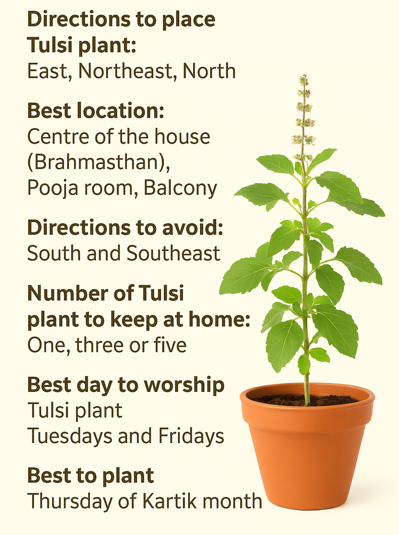
Where to keep Tulsi plant at home according to Vastu Shastra?
East
East is the direction of the rising sun and ruled by the king of devatas Indra. This direction is associated with positivity and new beginnings. Hence, keeping the sacred Tulsi plant in the east direction is considered auspicious and said to promote positive vibes, ensure growth and vitality.
Northeast
The northeast direction as per Vastu, also called the Ishan Kon, is considered auspicious for creating a home temple. It is connected with abundant positive energies and gets maximum sunlight. A Tulsi plant can be kept in this direction, which will ensure good health, wealth and overall wellbeing of the family.
North
The north direction is the direction of water and ruled by the god of wealth Kuberas. Placement of the Tulsi plant in this direction will help set a positive environment at home by inviting the good energies and eliminating the negative energies.
Ideal locations to keep a Tulsi plant at home
- Centre of the house: Also known as the Brahmasthan, the centre of the house is considered a sacred area as per Vastu. Keeping a Tulsi plant in centre of the house can help energise the space.
- Pooja room: The home temple is another sacred space in the house, which is an ideal spot for keeping the Tulsi plant and helps create a positive environment.
- Balcony: You can keep the Tulsi plant in an open space such as the balcony in the Vastu-recommended direction.
- Near a window: You can also consider placing the Tulsi plant near an east or north-corner window that receives adequate sunlight.
Locations to avoid
Ground: Since the Tulsi plant is worshipped and is regarded as sacred, one should not plant Tulsi directly in the ground. Make sure you keep the plant in a pot and plant it on a raised platform.
Bathrooms and damp areas: Since Tulsi plant is revered, it should not be kept near bathrooms as they are sources of negative energies. Moreover, the plant requires an airy space with ample sunlight, so it should not be kept in damp areas.
Kitchen: Tulsi plants should not be kept in the kitchen. Usually, kitchens are built in southeast corner and this direction is not recommended for Tulsi plant as per Vastu.
Bedrooms: The bedroom is not an ideal place to keep a Tulsi plant. It is an indoor space without access to sunlight and keeping a Tulsi plant here can disrupt the overall energy flow.
Things to keep in mind when placing Tulsi plant at home
- Ensure sufficient sunlight is available near the plant.
- Do not place things such as brooms, shoes or dustbins around the planter.
- Ensure that the area around the plant is neat and clean.
- Always place flowering plants near the plant.
- Avoid thorny plants like cactus near the Tulsi plant.
- Avoid keeping a dry plant in the house as it attracts negative energies.

See also: Vastu tips for bamboo plant at home
Directions to avoid
South
One should avoid placing Tulsi plant in the south direction as per Vastu as it can attract negative energies and may lead to losses or difficulties in married life.
Southeast
The southeast direction is associated with fire and suitable for places such as the kitchen. One should avoid keeping the Tulsi plant in the southeast direction it can bring negative effects.
Southwest
The southwest direction is associated with the earth element and is ruled by planet Rahu. This direction is not suitable for placing Tulsi plant as per Vastu.
West
As per Vastu, the west direction is related to metal, air and space. Tulsi plant should not be placed in the west direction as it can attract negative energies.
Northwest
The northwest direction is associated with the wind element, denoting change and movement. One should avoid keeping Tulsi plants in the northwest direction.
Can Tulsi plant be placed in front of main door?
According to Vastu, the Tulsi plant should be placed in an open space that receives optimum sunlight. An ideal location to keep the Tulsi plant is the front of the main entrance door of the house in the recommended directions – north, northeast, east or centre. This placement will prevent negative energies from entering the house and promote positive vibrations around the house.
Why is the Tulsi plant not kept inside the house?
In most households, the Tulsi plant is placed in outdoor spaces such as balconies. However, some people place the Tulsi plant on rooftops due to the lack of space inside the house. According to Vastu, placing the Tulsi plant on rooftop or terrace is considered inauspicious as it can lead to business or financial loss.
Benefits of Tulsi plant as per Vastu
Therapeutic benefits
- The leaves of Tulsi are widely known for their medicinal properties and used in Ayurveda, which is an alternative system of medicine.
- Tulsi, which is known to have anti-viral, anti-fungal and anti-bacterial properties that help fight infections, helps in fighting various diseases and conditions, including cancer, heart-related diseases, respiratory illnesses, skin problems, bacterial infections, etc.
- Consuming Tulsi tea has also been found to be beneficial for people with liver problems.
- Moreover, Tulsi is also used as a herb in cooking.
Promotes a peaceful environment
As per Vastu, the Tulsi plant is an auspicious plant that should be placed in the house to create positive vibrations. Apart from its medicinal properties and many health benefits, the presence of tulsi plants helps in eliminating stress.
Tulsi helps purify the surroundings
The plant creates a pleasant aroma, which keeps the surrounding fresh. Keeping this plant at home purifies the air. It is believed that the tulsi plant absorbs toxic gases such as sulphur dioxide, carbon dioxide, carbon monoxide, etc., from the air. The plant also keeps mosquitoes away with its mosquito-repellent qualities.
Balances the five elements
Keeping the auspicious Tulsi plant at home creates a balance between the five elements of nature – earth, fire, water, air and space. This ultimately helps create a harmonious environment.
See also: Money plant benefits
Tulsi promotes a blissful marital life
As per Vastu Shastra, worshipping Tulsi plant leads to a happy married life for couples, and brings peace, wealth, and prosperity.
A special Tulsi pooja is done every year on the Ekadashi Tithi of Shukla Paksha or on the eleventh bright day in the Kartika month. As per Hindu religion, a ceremony known as Tulsi Vivah is performed one of these days before the beginning of the wedding season. In this ceremony, the ceremonial wedding of Lord Vishnu with Tulsi is conducted in temples and homes. The Tulsi plant is adorned like a bride and a shaligrama, a sacred stone, is used to represent Lord Vishnu.
Religious significance
In the Hindu religion, the sacred Tulsi plant has great significance and is used in various pooja rituals.
- Tulsi leaves are used in making the panchamrita, a holy drink made from milk, ghee, curd, honey and sugar.
- The Tulsi plant is believed to have self-purifying nature and can cleanse itself. Therefore, if can be washed and reused for pooja.
- Tulsi leaves are offered to the deities for worship. They are also used in making garlands or mala for adoring the deities as a part of the Alankaran ceremony in poojas.
- As per the Hindu culture, the Tulsi leaf is associated with Lord Vishnu and is offered to please the deity. All sacrifices to the deity are incomplete without it. Vaishnavas usually generally wear Tulsi mala when chanting Vishnu mantras. This helps generate positive vibrations.
- The woody stem of the Tulsi plant is widely utilised in making beads for rosaries or japa mala.
Spiritual benefits
It is believed that offering Tulsi leaves to deities provides strength to fight evil forces and sinful activities around. Tulsi leaves are offered to Lord Vishnu and Krishna during worship, as it is said to purify the offering and the prayers.
According to Vastu, Tulsi leaves should not be offered to Lord Shiva since Tulsi is regarded as the wife of Shankhchud who was defeated by Lord Shiva.
Mythological significance
Once Lord Krishna hosted a Tulabhara, an ancient practice where a person is weighed against commodities such as grains, vegetables, coins, gold, etc. He sat on one side of the balancing scale and all the gold jewellery of Satyabhama, his third queen-consort, on the opposite pan of the balance.
During this event, Lord Krishna could not be outweighed by the weight of the jewels. Then, his second queen, Rukmini, placed a single tulsi leaf on the other side, which tilted the balance. The story proved that even Lord Krishna believed Tulsi as superior to him. Thus, Tulsi plant is highly revered.
Tulsi Marriage or Tulsi Vivah
In India, Tulsi marriage is celebrated in homes and temples just like a traditional Hindu wedding ceremony. The ceremony is performed by marrying the sacred plant to Shaligram form of Lord Vishnu.
Tulsi plant with other Vastu elements to maximise benefits
The Tulsi plant, in its own right, is a powerful source of auspicious energy and can elevate the spiritual vibes of any space in the house. However, there are ways to combine a Tulsi plant with other Vastu elements to maximise its benefits and create a harmonious environment that positively influences various aspects of life. Here are some examples:
Near water elements: The ideal location for plants is near water features, such as fountains, according to Vastu. So, a Tulsi—the earth element—can be kept close to a water source, such as a small fountain or Urli, in the northeast.
Wind chimes: According to Vastu, they bring the benefits of the air element and can be placed with Tulsi plants to boost energy flow in a space and enhance spiritual vibrations.
It is important to note that Tulsi plants should never be placed with the fire elements or in the southeast direction. The conflicting energies of sacred plant energy and the fire element can lead to an energy imbalance, impacting health and harmony.
Which Tulsi is best for home?
You can keep either of these two varieties of Tulsi plant at home. Both Rama and Shyama Tulsi plant are widely popular for their medicinal benefits.
The Holy Basil or green Tulsi plant is the commonly available Tulsi plants considered auspicious as per Vastu Shastra. There are different variants of the Tulsi plant in India.
Rama Tulsi
The Tulsi with green leaves is called ‘Shri-Tulsi’, also known as ‘fortunate Tulsi’ or ‘Rama-Tulsi’ or ‘bright Tulsi’. Rama Tulsi (Ocimum Sanctum), is known for its healing properties and used for religious purposes. The taste of the Tulsi leaves is sweeter than other Tulsi variants.
Shyama-Tulsi
The Tulsi with dark green or purple leaves and purple stem is called ‘Shyama-Tulsi’ or ‘dark Tulsi’ or ‘Krishna-Tulsi’. It is associated with Lord Krishna because its purple colour is similar to Lord Krishna’s dark complexion. Shyama Tulsi is also known as Krishna tulsi (Ocimum Tenuiflorum) is the Tulsi variant with unique medicinal benefits like cure for throat infections, skin diseases, ear ache, nasal lesions and respiratory problems.
Kapoor Tulsi
This form of tulsi is known for its healing properties and fighting many life-threatening diseases. It has an aromatic smell that keeps inspects and mosquitoes away.
Vana Tulsi
Vana Tulsi is a wild variety of Tulsi characterised by its jagged green leaves and sweet flavour. As the name suggests, this variety of holy basil is widely found in forests and is also commercially cultivated.
How to worship Tulsi plant at home?
As per Vastu Shastra, one should follow certain rules when worshipping the Holy Basil or Tulsi plant and creating a simple Tulsi mandir design at home.
- Design a Tulsi chaura in the northeast corner of your balcony or outdoor space.
- Keep the surroundings near the Tulsi plant clean and clutter-free. This is important to attract positive energies in the house.
- Light a ghee or an oil lamp near the plant.
- Offer water from a Kalash to the Tulsi plant. Always hold the kalash with both the hands.
- Offer holy items like kumkum, haldi, flowers and incense.
- Chant shloka while circumambulating
See also: Lucky plants for the home
Tulsi Chaura Vastu tips
When keeping a Tulsi plant at home, one should always ensure the plant the is placed on an elevated platform. Since the Tulsi plant is revered, it should not be placed directly on the ground. It should at least be placed on a windowsill or balcony space in the Vastu-recommended northeast corner. An excellent idea to place a Tulsi plant is designing a Tulsi chaura or plant pot. You can consider auspicious materials such as marble, granite or any stone for designing a Tulsi chaura. Wood, terracotta and cement plant containers are other options to choose. Avoid artificial material such as plastic for placing a Tulsi Plant.
How many Tulsi plants should be kept at home?
According to Vastu Shastra, Tulsi plants must be kept in odd numbers such as one, three or five. This will ensure the house receives the maximum benefits from the plant. Moreover, the count of odd numbers like one, three and five complies with the principles of balance and harmony.
Can having too many Tulsi plants impact Vastu of the house?
According to Vastu Shastra, placing Tulsi at the wrong locations can have negative effects but a few Tulsi plants at home is not considered totally negative. Care should be taken to keep the plants healthy and prevent them from drying. However, keeping Tulsi plants in excessive number may be difficult to maintain and disrupt the energy balance. Thus, too many Tulsi plants should be avoided.
Vastu guidelines for plucking Tulsi leaves
- According to Hindu traditions and Vastu guidelines, one should not pluck Tulsi leaves after sunset and at certain times.
- Tulsi leaves must not be plucked with a nail. One should use their finger to pluck the leaves.
- Avoid touching the Tulsi plant or plucking its leaves without taking a bath.
- One should avoid plucking Tulsi leaves on a Sunday, Amavasya, Dwadashi and Chaturdashi.
Why should we not touch or water Tulsi plant on Sunday?
According to Vastu, one should not touch or water the Tulsi plant on Sundays and certain days such as Ekadashi, lunar and solar eclipse, because, as per mythology, goddess Tulsi fasts for Lord Vishnu on Ekadashi. Watering and touching the plant or plucking its leaves will be considered as breaking the fast and the plant is believed to dry as a result. Not touching the plant is a way of showing respect to the deity. On the other hand, watering the Tulsi plant on a Sunday or other prohibited days can invite unwanted negative energies into the house.
Tulsi plant as a Vastu remedy
Tulsi plants, owing to their auspiciousness, can be an excellent solution to remove Vastu dosha and negativity from the house. Keep a brass vessel filled with water and four to five Tulsi leaves overnight. The next morning, sprinkle this water on the main door to eliminate negativity and invite positive energies in the house.
Housing.com News Viewpoint
If you are planning to add some plants to your house, consider the sacred Tulsi plant, which offers many benefits. The leaves are also used as an herb in cooking and making tea, due to its medicinal benefits such as stress relief, lowering of blood sugar, boost in immunity, etc. Moreover, from a Vastu angle, the plant is greatly beneficial as it serves as a protection against negative energies and purifies the space. It is essential to consider the Vastu guidelines when placing the Tulsi plant at home to avoid any negative effects.
FAQs
Why Tulsi is not kept inside house?
The Tulsi plant must be kept in an area with sufficient sunlight for its healthy growth. Moreover, it creates positive energy around the house and keeps negative energies away. According to Vastu experts, keeping Tulsi on the terrace can lead to financial loss.
Is it OK to gift Tulsi plant?
Tulsi is an auspicious plant which can be presented as a gift.
| Got any questions or point of view on our article? We would love to hear from you. Write to our Editor-in-Chief Jhumur Ghosh at jhumur.ghosh1@housing.com |


